




A word from the Headmaster
“Schools must remain inviolable sanctuaries where the quarrels of men do not penetrate.”
Jean ZAY, Minister of National Education from 1936 to 1939
Ladies and gentlemen, students and their parents,
It is with great pleasure and honor that I took over the leadership of this fine institution at the start of the 2023 academic year, an institution with a very rich history since its opening in 1886. With my deputy, Ms. Mabed, alongside the teaching and educational teams, with their recognized skills, their dedication and their strong commitment at every moment, I wish to make the full success and the best possible development of the students the priority of the high school.
Within a framework that respects the law, rules and authority, in a serene and studious atmosphere with a pleasant and secure environment, rest assured of my full and complete commitment to the fulfillment of the staff's missions for a demanding but caring School of the Republic that guarantees the chances of every student.
Eric PFAFF
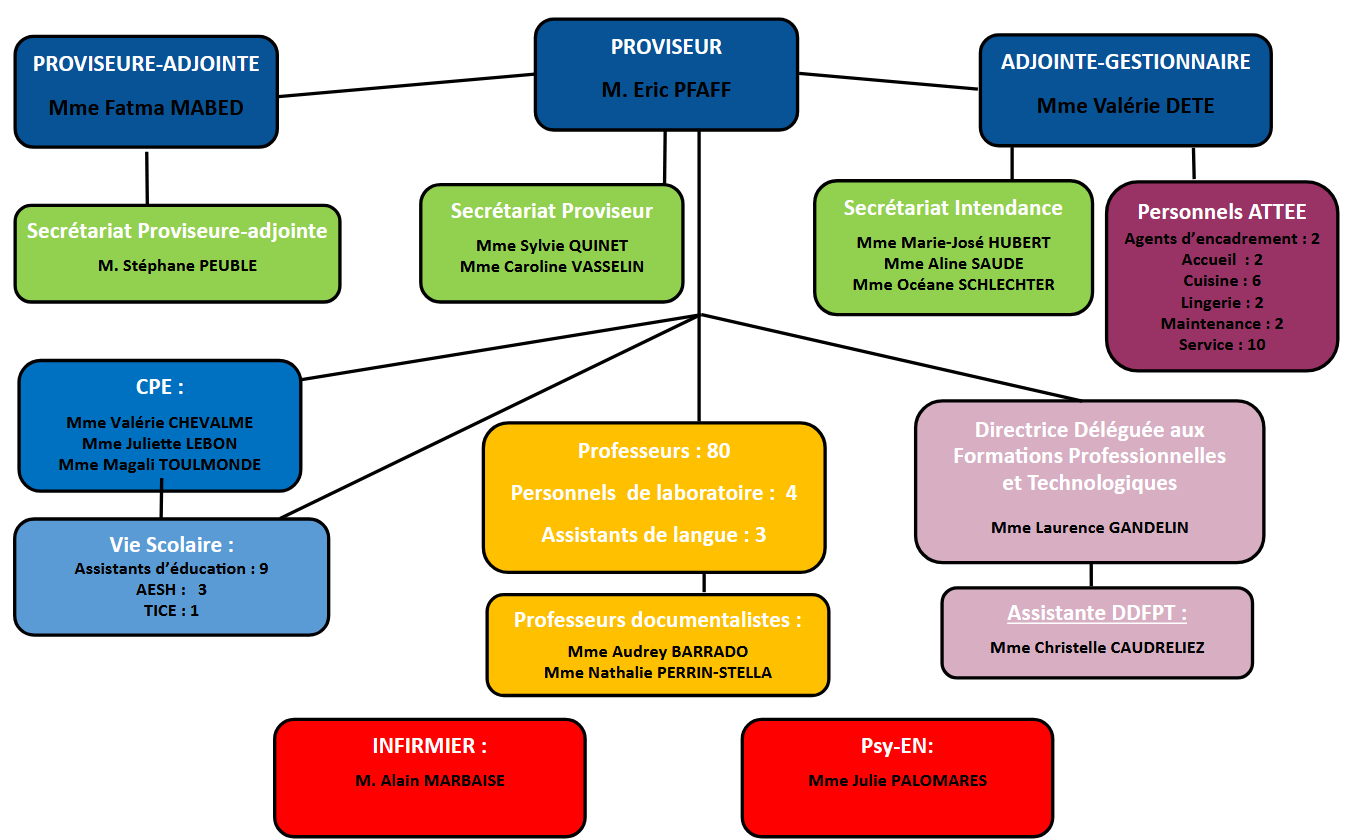
Organizational chart of the Sévigné high school
The role of each
The Headmaster
The headteacher, or principal, is in charge of the high school. This entails several roles:
1/ He is the representative of the Ministry and the State. As such, he represents the institution externally and is in contact with the Ministry, the Rectorate,
the Academic Inspectorate but also with the relevant local authorities such as the Region and the municipality.
2/ He is the authorizing officer for expenditures and responsible for the establishment's budget, which is carried out jointly with the manager.
3/ He is the educational coordinator for the school. He defines the school's educational policy through the allocation of teaching hours assigned to the high school, in accordance with national education laws and regulations, in line with the school's strategic plan and in consultation with school staff. Along with the Deputy Headteacher and the Director of Vocational and Technological Education, he chairs the class councils.
4/ In general, he acts in all areas concerning the life and operation of the establishment. He is responsible for ensuring the safety of people and property in all circumstances. For a number of decisions, he relies on other staff (deputy headteacher, DDFPT, CPE, administrator, nurse), as well as on the Board of Directors where representatives of the school community sit (staff, parents, students and local authorities).
The Deputy Headmistress
As her name suggests, she is the deputy headteacher. She is particularly in charge of the organisational aspects of the high school: class and teacher timetables, room occupancy, setting up and managing exams and common assessments, centralizing and managing grades (computerized) and term reports, monitoring student guidance and Parcoursup.
The Deputy Director for Vocational and Technological Training – DDFPT
Placed under the direct authority of the head of the establishment, she participates, as an advisor and close collaborator of the latter, in the same way as the deputy and the deputy manager, in the work of the management team and in the bodies of the establishment where her presence is required.
Its missions apply more specifically to all technological education and can be broken down into four main areas:
- She is the advisor to the head of the institution for technological education, particularly regarding training programs and integration.
professional development for students or further studies, development of technical facilities, but also for the promotion of the institution,
- It is involved in the organization of teaching, such as managing educational projects, developing timetables for technological and BTS programs, and managing and coordinating the use of premises and equipment.
- She coordinates and leads the actions of teaching teams, as well as the revisions of training frameworks under the guidance of the subject inspector. She supports teachers in the preparation and implementation of various multidisciplinary educational projects related to the school.
- She manages relations with external partners. For example, she is involved in the organization of work-based training periods, collaborating with companies and local authorities, or developing international exchanges.
The Senior Education Advisors (CPEs)
The CPEs (Student Life Advisors) are responsible for managing and organizing student life. Their responsibilities are exercised in three areas:
- Responsibility for monitoring student numbers, attendance and punctuality, organizing the duties of supervisory staff, and managing student movements. They participate, within their respective areas of responsibility, in the implementation of measures designed to ensure safety, particularly that of students.
- collaboration with teaching staff, nurse, PsyEn, parents: exchange of information on the student's behavior and activity: his results, the conditions of his work, monitoring of class life.
- Educational animation: direct relations and contact with students on a collective level (classes or groups) and on an individual level (behaviors, work, personal problems); organization of consultation and participation (training, election and meetings of student delegates, educational projects).
The General Manager-Secretary
The manager handles the establishment's budget, expenses and revenues, all material aspects, maintenance of premises, but also all the so-called ATTEE staff (kitchen, maintenance, reception, professional workers).
She also works with the head chef to manage the school cafeteria (purchasing food, inventory, menu planning, payment for half-board, etc.). Generally speaking, she handles all financial matters.
Students can go to her (or her secretaries) for questions about half-board, but also for requests for help with meals, high school scholarships, or one-off assistance with the social fund.
The Secretaries
There are two types of secretaries:
- Secretaries to the Headmaster and/or Deputy Headmaster
- Administrative secretaries (of the manager).
They are responsible for managing teaching and educational staff, as well as administrative documents in their respective areas. Students will see them first when they have an administrative or financial request.
The Professors
Teachers are responsible for all of the students' educational activities. They deliver their lessons in accordance with the official curriculum, assess their students' knowledge and evaluations, and prepare them for various exams. They work in collaboration with their colleagues in the classrooms. Teams are made up of teachers who are responsible for the same classes or groups of students, or who work in the same subject area.
They provide support for students' work and personal monitoring, and advise them in choosing their career path, in collaboration with education and guidance staff.
The Head Teachers
Form teachers hold a special place within teaching teams. Each class has its own form teacher or lead teacher, who coordinates all the teachers on the team. In this capacity, they work with the student life coordinator or any other partner who can assist them in their work.
He centralizes information and administrative documents and distributes them to both colleagues and students. He participates as the lead teacher in class councils, providing an overall assessment of the class's progress. He is also a key contact person due to the relationships and dialogue he can establish with families.
Laboratory Staff
They are responsible for assisting professors of scientific disciplines in preparing lessons, practical work, or experimental activities. They work alongside professors of one or more disciplines. They prepare and may also perform maintenance on experimental equipment.
Under the authority of the head of the establishment and their deputy manager, they ensure the safety of the premises and the removal of solid and liquid biological and chemical waste before any work is carried out on the workbenches, floors, walls, windows, etc., by the technical staff of the local authorities responsible for the general and technical maintenance of the establishment. In this capacity, they ensure the implementation of the laboratory's specific hygiene and safety rules.
Teacher-Librarians
Teacher-librarians welcome students to the CDI (Documentation and Information Centre) for documentary research they may need to carry out, consult books, read, borrow books, etc. They work regularly with teachers and welcome classes or half-classes for specific sessions.
Part of the CDI is dedicated to career guidance with a whole series of documents made available to students who wish to find out about their career options.
Education Assistants
Their role is to supervise students during all times when they are not in class: lunchtime, breaks, study hall, etc. They can help students with their schoolwork, particularly during study hall. They also have a number of administrative tasks, such as recording absences and sending letters or making phone calls to families, monitoring detentions, etc. Their work is organized by the CPE (Educational Advisor), who is their supervisor.
Language Assistants
French language assistants (in English and Spanish at the high school level) are assigned to schools (primary or secondary) or universities for a period of between 4.5 and 12 months depending on the destination.
The assistant's role is to improve students' communication skills, particularly oral skills, and to deepen their knowledge of French culture. They work in support of the French teachers and may participate in whole-class sessions in their presence or work with small groups of students separately.
The assistant's specific skills allow him to encourage students to express themselves orally, to bring a playful dimension to learning, and to debate socio-cultural themes likely to interest children and adolescents.
It can perform one or more of the following functions:
- oral language practice with students alongside the teacher
- conversation classes with students
- Introduction to French civilization and culture
- personalized student support
- participation in the implementation of an exchange project
- running a language club
- contribution to the production of accompanying educational materials (video and audio recordings)
- Optionally, assistance in preparing for French language diplomas or certificates: DELF/DALF - TCF
Kitchen Staff
The kitchen staff checks the quality of the food and goods ordered and prepares meals for students and staff.
He is also responsible for the upkeep of the kitchen and dining room.
Maintenance Staff
The maintenance staff are responsible for cleaning all the school buildings: classrooms, corridors, as well as courtyards, playgrounds, and all green spaces. They are in charge of maintaining and repairing all the school's facilities.
The Nurse
The school nurse participates in welcoming and supporting each student according to their specific needs related to their physical or mental health. She contributes to this objective by promoting the health of all students.
She participates in health education and risk behavior prevention projects conducted in schools and thus plays an overall educational role within the school community. She takes into account the well-being of the educational community and contributes to building a school that is caring towards students and their families.
The nurse's responsibilities include providing preventive and curative nursing care and designing, evaluating, and implementing health education initiatives in both individual and collective settings.
On an individual level, preventing the essential problems that young people may encounter (academic failure, relationship difficulties, harassment, distress...) requires tailored and personalized responses from qualified professionals.
The school nurse's role is to welcome and listen to the students entrusted to her care in order to determine their health needs and contribute to their education for social and professional integration. She helps them develop their critical thinking skills, build their autonomy, and create a personal health plan. She is also concerned with fostering students' reflection on the meaning and scope of the values that underpin our institutions and preparing them for the full exercise of citizenship.
The School Doctor
The school doctor for the national education system is shared between several schools. Their mission is to promote the physical and mental health, as well as hygiene, of students. They play a role in screening through medical check-ups, prevention (STIs, substance abuse, etc.), health education, and monitoring of students at risk or experiencing difficulties.
The National Education Psychologist
The school psychologist (PsyEN) is there to inform students about possible career paths and study choices for their future education. She undertakes extensive educational work to ensure that each student is able to choose a positive path that aligns with their professional aspirations and abilities.
To achieve this, she intervenes individually through appointments with students.
She also plays an important role in listening to students who need to confide in her (psychological support), as well as providing assistance to students experiencing difficulties. She is present at the high school one and a half days a week but can also meet with parents and students at the guidance center.